
Passion or Process?
How to find what you love...
I have been reading a study authored by three psychologists - one from Yale and two from Stanford, arguing that passions in life don’t suddenly appear like a rainbow you can follow to the pot of gold . No, passions in life, like itself, are a make it up as you go along process.
The argument goes that most kids are interested in most things until around the age of 8. After that, parents and teachers have to teach them discipline in what they enjoy doing ( so they get better) while encouraging them to explore new things too.
Then there is the question of how to earn a living. Most artists know that problem first-hand, whether writers or musicians or actors or directors, dancers, visual creatives. We have to eat and sleep with some measure of satisfaction, and that means paying the bills, perhaps by doing a job that is dull, so that we can be less dull, after-hours.
The study asked students to fill in a form that divides them into Techy - maths, science, tech, or Fuzzy - arts and humanities.
Yes, I agree, that’s a reductive and insulting division. There is nothing fuzzy about art or the humanities. Never mind. Ignore the ignorance. Psychology loves a label. But the core of the question that prompted the study is interesting. Just now, the fashion is passion. Find your passion and the rest follows. But is it true? And even if it is a little bit true, is it helpful?
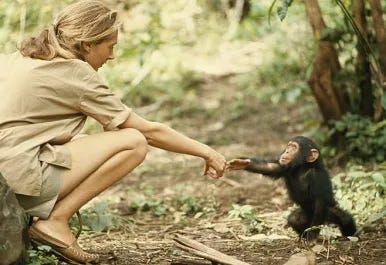
Jane Goodall died last week. She was 91. Still giving lectures across the world. The British primatologist worked with chimpanzees from the 1950s, radically altering human understanding ( read male understanding) of primates themselves, and the relationship between humans and chimps. Goodall blasted primatology apart, first by demonstrating that chimps in the wild are tool-using animals, just like humans, and more controversially, by using love and kindness as research methods. Her subjects were not objects.
Chimps have had a terrible time in both medical research and in psychology experiments - the horrible operant chambers devised by 1930’s American psychologist, BF Skinner, designed to depress animals into submission. These boxes - still in use - have no beauty or comfort - think plastic, metal, electric light, and systems of punishment and reward. The idea is to isolate the animal, in order to discover how behaviours can be learned, or unlearned. A Skinner Box removes the animal from any semblance of a natural environment and then monitors behaviour under a series of controlled conditions. It was, and is, grotesque. What do we learn from induced misery?
Jane Goodall’s passion was not to induce or reduce, but to to be present with non-human creatures in their own environment. Her work stood against human exceptionalism, instead looking for links and connections. She was derided for naming the chimps she worked with. Male researchers preferred letters and numbers and the pronoun ‘it. Goodall carried on, quietly, and with certainty, would not back down, would not give up. Her death is a loss to science. Her death is a loss to humanity.
Few of us will be Jane Goodall. That doesn’t matter. There was one thing she was here to do - reset our outdated relationship with the animal kingdom - and that’s what she did. She was a Chosen One. A Hero.
But what about the rest of us? Especially when everything in our culture is now about standing out, being different, following your dream, showing the world this is YOU. No-one is supposed to be satisfied with the ordinary. No-one is supposed to accept the script they are given. We are all going to be rich and famous… or we would be.. if we followed our passion.
It’s rubbish. It’s marketing. It’s advertising. It’s cynical. It’s a lie.
The horrible stuff coming out of Skinner’s operant chambers did teach us something. Skinner’s cold-blooded research gave modern capitalism the tools to influence and control humans - not chimps and rats and cats. How to disorientate and delude, how to cower us, or flatter us into wanting rewards and avoiding electric shocks - how to convince us that we are trapped - except for the one way out offered by the men in white coats, or the advertorial that will change your dismal life. The modern advertising industry that kicked off in the 1960s ( you have all watched Madmen, right?) took its tricks from Behaviourism ( Skinner). How to get people to want things they don’t want, to crave things they don’t need, to seek status and reward via objects that can be bought. To compete for resources. To love our captors. To press the lever and get a peanut.
Throw social media in the mix 50 years later, and here is a self-created hell. Everyone (except you) is living their dream, following their bliss, finding their passion. In reality, folks are living with their parents, doing gig jobs, getting no sex - or having sex with thousands of strangers, hoping to be an influencer, wondering why 100k salary means thy can’t afford a home in London or New York. Wondering how to follow their passion and work in theatre for 20k.
We are pressing the lever. Where are the peanuts?
Here’s the thing. It’s all a category error.
Your passion really might be the thing that carries your through life but don’t expect it to make you rich and famous or pay the bills.
What we love is a personal thing. Jane Goodall didn’t set out, as a young woman, to be one of the most famous primatologists in the world. Einstein didn’t care about winning the Nobel Prize when he was working out equations on scrap paper at the Zurich Patent Office where he worked as a young man.
Passion is not a means to an end. It is an end in itself.
My students come to me, and of course, they all want to be important published writers. It’s not going to happen. It doesn’t happen. Does that mean anyone who loves writing and wants to write should give it up? Not at all! There are plenty of platforms out there! This is one of them. So what if you have to have a full-time job? You go on doing what it is you want to do - regardless of reward. If you give it up, you lose something really valuable. Maybe the outside world doesn’t value it, in terms of money or recognition, but you value it. That matters.
People still sing in choirs, play in bands, form reading groups, baking groups, bike round the world, or just bike to work every day. Learn a language. Remember that they always wanted to tap-dance. Buy that rusted car and spend weekends in a freezing garage. Go wild swimming. Build a model railway.
It doesn’t matter. The terrible swindle - the category error - is to assume that how the money gets earned is who you are. That’s not who you are. It’s part of who you are. It’s important, yes, but the real effort is to keep aside a private self not for sale in the market place. Even if, especially if, you are successful.
What you love, how you are rewarded in this world - it’s complicated.
And you might be in a bullshit meaningless job. Don’t drive yourself mad. If you can’t change it - make it work for you, by which I mean, if it’s just a pay packet, accept that, and hoard your treasure elsewhere.
Your family life might be your passion. Your volunteer work. The books you have promised to read. And as we live long and move through life, those passions can change That’s not failure. Sometimes we are done with it. It’s over. Like the last page of a stamp collection.
In this slog of a late-capitalist world, too much tedious work has cut off people from their passions. What can we be interested in, or curious about, when we are exhausted? Mothers bear a double burden here. How to dream when you don’t get enough sleep? It’s nearly impossible but it’s not impossible. You are still there, under the rubble, maybe, but still there.
If you are young, and looking to make your way, be realistic as well as idealistic. Mum and Dad can’t support you forever. The world doesn’t care whether you live or die. Find your own way through the lies and cheats. Including the Be Yourself mantra. You can’t be anything unless you are out there, however humble, testing who this Self is that you want to Be.
And if you are interested in nothing? If you are empty and bored? That’s because you live in an operant chamber. Late capitalism is a stripped bare operant chamber. There is too much artificial stimulus, fake reward, and nothing that a human really needs - like connection, beauty, an open environment where we can be curious. Where we can learn and change. A home of our own would be a start. So much has been taken away.
Yet, I don’t believe that there is no hope or that we face a life endlessly hoping to find this passion - just as people endlessly hope to find the ‘one’. We start from here, where we are, and have a look at what our life is - the realistic bit - then we start exploring where, or why, we feel muffled or dead, or held back, or depressed. This is hard and painful stuff. But from this hard and painful assessment of where we are, in a closed and indifferent world, there will be a light beam. It might not be a big move or a big change. It might be a walk every morning - and see where that leads. It might be a book club - and see where that leads. It might be volunteering at the Food Bank. When we feel trapped out we have to turn a wall into a door. A lab animal can’t do that. A human can.
Maybe you won’t find the passion, the cause, this thing that makes sense of you, but look again, and see that in every step, every decision, every action, you are making sense of you. That’s process as well progress. Living in a generous, connected way, flexing your mind, being intelligent, contributing to the community you inhabit. Just life without marketing. Life without being sold the dream. Life without the mission statement. Life based on what you believe in, and work at, in your own way, not because it’s fashionable or influenced. not the checklist or the milestones or the goals. Life like the bite of an apple at breakfast.
Life. This now
.
My 25-year old self could have used this kind, honest essay back in 1984. But my 60-something self is grateful you wrote it and nodding in absolute agreement. I wonder if my teenaged granddaughters would read this if I sent it to them…
Yes. Late stage capitalism is an empty plastic box. We’ve created that ourselves, the clever, exceptional species that we are. The older I get, the sadder I am to see the natural world shrinking, but also, the more I love it (the animals, trees, mountains, rivers). The older I get, the less I care about my passion or my career, the more I care about the plants and animals and ecosystems that have for so long been nothing but a resource for us to exploit.